
The Architecture of a
Hybrid Training Engine
When software treats strength, endurance, and systemic recovery as parallel universes, your body pays the toll. Here is why fragmentation breaks athletes—and what structural integration actually solves.
The Fragmentation Failure
Look at your current software stack. You likely have an endurance platform dictating your runs and rides via auto-generated TSS targets, a separate app or spreadsheet managing your strength and barbell tracking, a wearable wrist-strap telling you how physically and neurologically tired you are, and a generic mobility app you open only when something already hurts.
None of these systems communicate. They are structurally blind to each other.
Your triathlon endurance app demands complex VO2 max intervals today because it has zero awareness of the heavy deadlifts you ground through yesterday evening. Your wearable flashes a red "Recovery: 24%" warning, but it doesn't plug into your training software to actually rewrite today’s track workout.
Physical stress is systemic. You only have one Central Nervous System (CNS) and one structural chassis. But your software is siloed. When planners don't talk to logs, you become the manual load manager, forced to absorb the biomechanical and physiological collision.
The Squat-Run Collision
A static marathon plan schedules a 90-minute tempo run for Thursday morning. On Wednesday night, you performed 5 sets of heavy back squats. Without a hybrid engine, the tempo run goes unchanged, and you attempt to hold a 6:45/mile pace on severely fatigued legs, risking a hamstring rupture.
The Engine Solution: A hybrid engine detects the high-load lower-body strength session and preemptively calculates the interference effect. It buffers the run, converting it from a Tempo objective to a Z2 Aerobic volume preservation session, or shifts the heavy squat day 48 hours away from key running intensities.
The "More Data" Trap
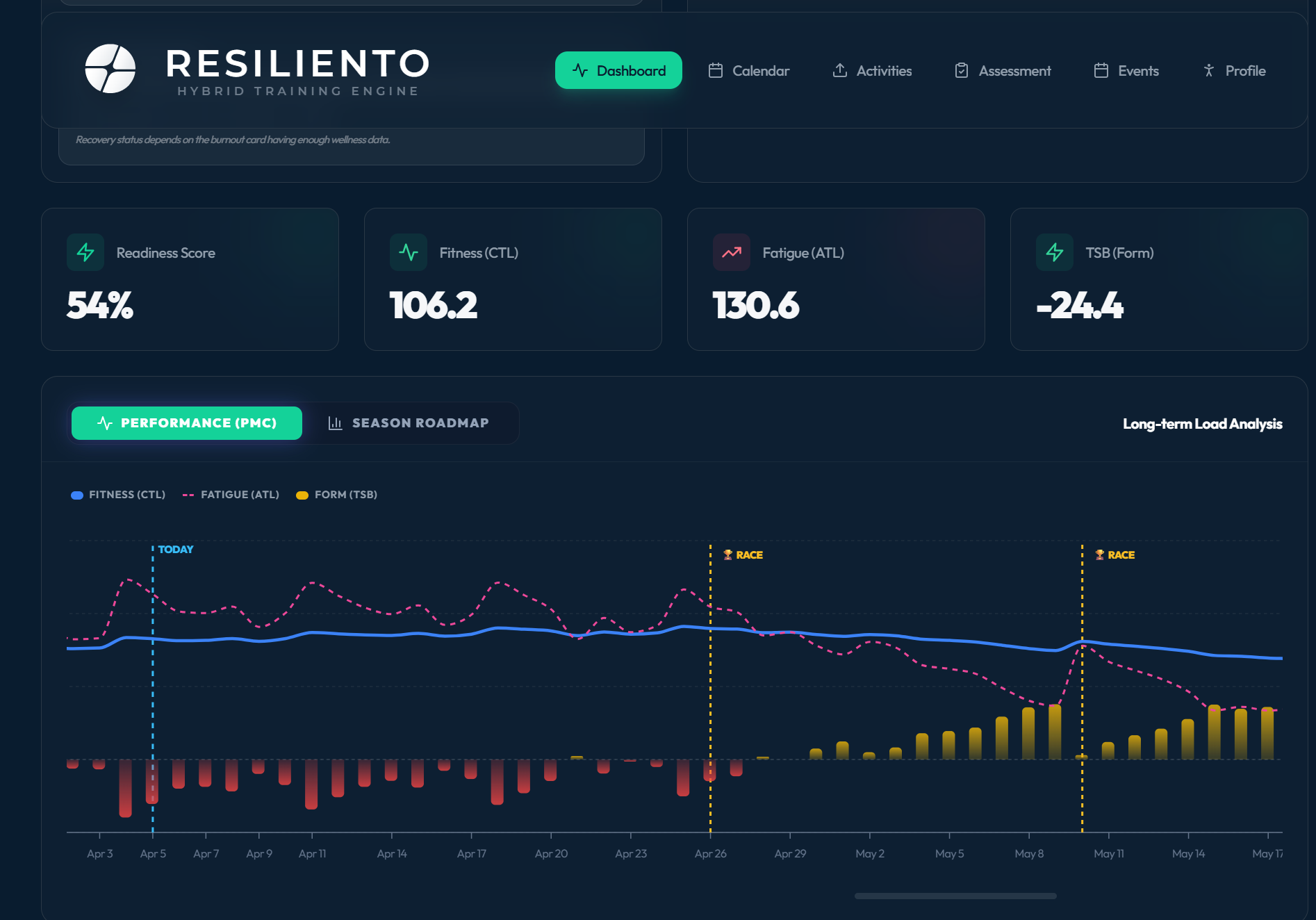
Your smart ring registers a terrible night of sleep, a suppressed HRV, and gives you a 32% "Readiness Score." But more data is not a solution if there is no algorithmic decision logic attached. A fragmented recovery score just makes you feel guilty while you try to execute the original training plan.
The Engine Solution: An integrated training engine ingests that 32% score along with your subjective perceived exertion from yesterday, and immediately alters today's objective. It formally downgrades the session to protect your macro-level trajectory.
What Defines a Real
Hybrid Engine?
Integration changes how decisions are made. A true hybrid engine process load, intensity, readiness, and biomechanical stress across all disciplines simultaneously, operating on three core principles.
Shared Load Budgets
Strength and endurance draw from the exact same recovery pool. The engine enforces a unified structural load ceiling. If your triathlon run volume peaks during a "Race Build" phase, the engine automatically compresses your strength volume down to "Maintenance Archetypes." It prevents you from simultaneously chasing maximum muscular hypertrophy and maximum aerobic endurance, which biologically cancel each other out.
Contextual Re-Routing
Plans must survive contact with reality. A missed long ride isn't just left behind, nor is it blindly stacked onto tomorrow. The engine algorithmically redistributes the physiological target across the upcoming week without violating daily acute load thresholds.
Explore Adaptive Planning →
Kinetic Protection
Mobility isn't a random 15-minute stretching video on YouTube. It acts as an integrated, prescribed correction. The engine observes the accumulated fatigue generated by your primary disciplines (e.g., hundreds of miles in aero position) and prescribes targeted positional fixes to counteract that specific muscular shortening.
Explore Structural Mobility →
Designed for Severe Requirements
Generic templates work fine for people who only run three days a week. The Hybrid Engine is built for athletes pushing the limits of physiological interference.
The 70.3 + Powerlifting Hybrid
Attempting to maintain a 500lb deadlift while building base volume for a Half-Ironman means your CNS is constantly under assault. The engine staggers peak strength blocks against lower-intensity aerobic build weeks, ensuring you aren't attempting to hit maximum wattage on the bike the day after maximum absolute strength outputs.
The Tactical / First Responder
Your schedule is unpredictable, and shift-work destroys sleep recovery metrics. You need high relative strength and elite work capacity. The engine reads the suppressed HRV from a 24-hour shift and immediately pivots a scheduled threshold-run into an active recovery row and mobility block, protecting your immune system.
Hybrid Engine FAQ
Is this just for elite triathletes?
No. It is built for any athlete managing concurrent training stress. Whether you are a dedicated powerlifter looking to run an ultra-marathon, a tactical athlete, or a cyclist trying to maintain upper body mass, the engine prevents the structural collision of conflicting adaptations.
How does it handle my wearable data?
It pairs your subjective fatigue inputs (how you actually feel) with objective markers (resting HR, HRV trends) to dictate the daily load state (Go, Compress, Downgrade, Recovery). Data acts as an input for the algorithm, driving real-time scheduling changes. It is not just a passive dashboard widget.
Can I still do my own custom strength program?
RESILIENTO provides highly structured strength archetypes that must dynamically adjust to your endurance blocks. While you can swap specific biomechanical movements (e.g., swapping a barbell back squat for a safety-bar squat), modifying the core phase-volume blocks manually breaks the integrated load calculation. The entire point of the engine is that everything must remain unified.
Stop Training In Silos.
Experience the only architecture systematically built to handle the catastrophic friction of concurrent hybrid training.
Join Waitlist→