
Static Plans Die
On Contact With Reality
Real life disrupts ideal schedules. Trying to perfectly execute a rigid 16-week template usually leads to acute injury or systemic burnout. Here is how dynamic algorithmic adaptation overrules arbitrary calendars.
The Inevitable Catch-Up Trap
Most athletes start a new block of training with a high degree of optimism and a rigid, 16-week PDF or static synced calendar. For the first two weeks, it works flawlessly. Then, inevitable friction happens.
A critical work meeting runs two hours late. You miss your Tuesday morning swim. Your child gets sick. Suddenly, your perfect plan becomes a massive source of anxiety.
Athletes with static plans have two very bad options when life gets in the way:
- They try to "catch up" by dragging the missed swim to Wednesday, stubbornly stacking it on top of a highly demanding track workout. Consequently, they are deeply fatigued for their Thursday ride, subsequently missing their critical power targets and arriving at the weekend structurally disjointed and over-reached.
- They delete the session outright, sacrificing the progressive overload required to force aerobic adaptation over the mesocycle.
Preserving the shape of the calendar at the expense of the physiological stimulus *always* backfires.
Handling The Missed Session
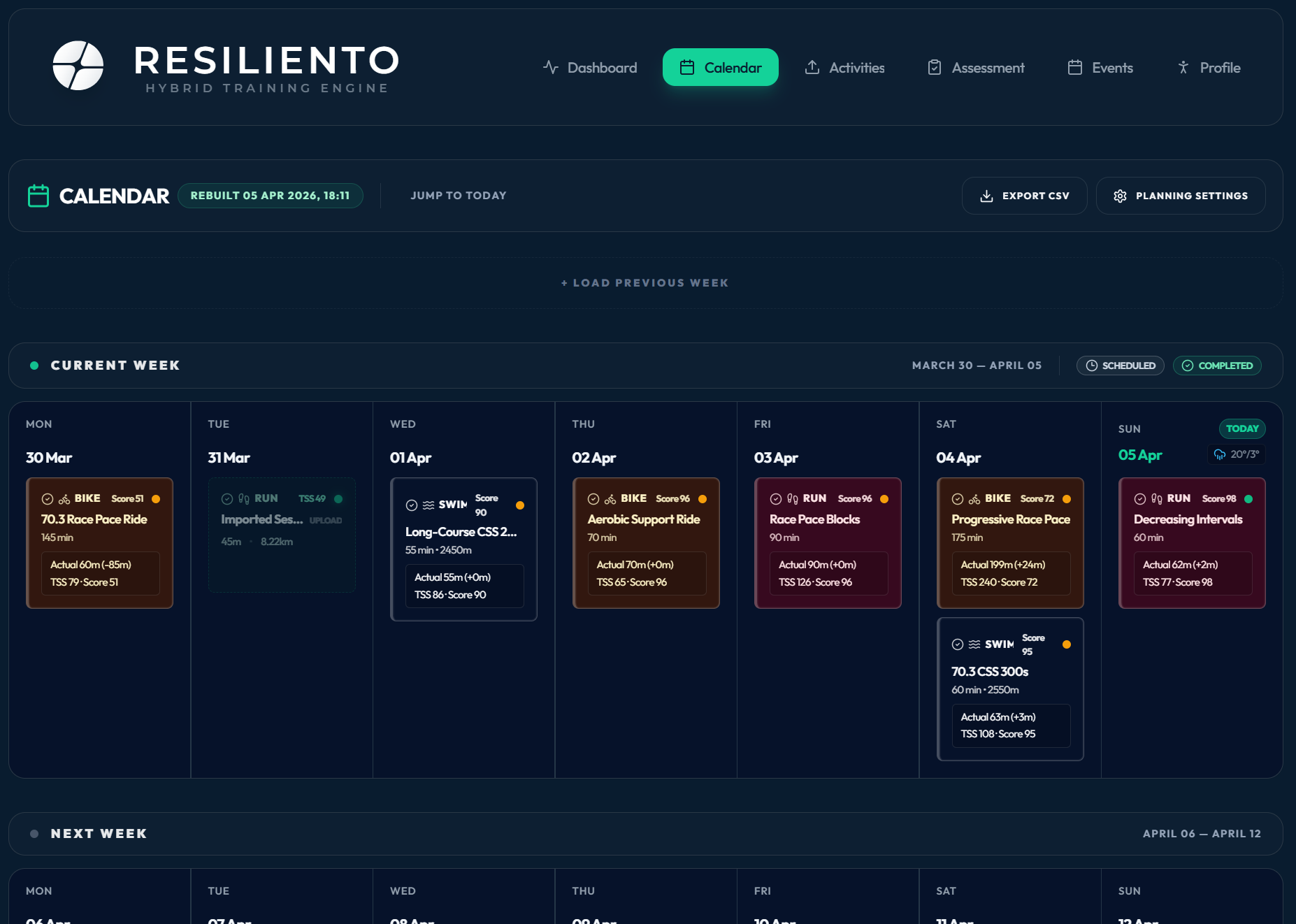
Missing a technical threshold session alters the weekly load distribution. Rather than blindly skipping it or unsafely stacking it onto tomorrow, an adaptive hybrid engine deterministically reschedules the highest-priority sessions inside the remaining 72 hours.
It redistributes the lost aerobic volume to alternative disciplines (e.g., adding 15 minutes of Z2 to your weekend ride) without causing an acute load spike that would compromise tissue integrity.
Smart Compression Algorithm
Your 90-minute structured ride is blocked because you only have a 35-minute window before leaving for the airport. Simply truncating the main set ruins the intended stimulus.
Smart compression calculates the required Training Stress Score (TSS) for the original workout and mathematically converts the steady-state aerobic blocks into a higher-density threshold or sweet-spot work, extracting an equivalent systemic stress score from the brutally abbreviated timeframe.
The Hierarchy of Adaptation
Consistency is not about flawless execution. The athletes who make the most progress are rarely the ones who heroically execute a perfect 16-week block. They are the ones who string together B+ weeks for 3 years straight.
Truncating
Stopping a workout halfway through because you ran out of time. You often bypass the core main set entirely or skip the critical cooldown clearing lactate. This means you absorb the fatigue of getting dressed and warming up, without actually earning the specific physiological adaptation.
Skipping
Wiping the session off the calendar entirely. You survive today, but if you do this twice in a week, the progressive overload of the mesocycle collapses. The engine's macro-level plan effectively derails, and your race volume projection drops below the safety threshold.
Algorithmic Adapting
The engine actively queries the remaining week, notes the exact Training Stress Score (TSS) deficit, and mathematically restructures tomorrow's session to ingest the lost volume, substituting intervals or modifying formats without ever violating maximum daily recovery caps.
Planner FAQ
If I inherently keep missing sessions, what happens?
RESILIENTO features a protocol called Horizon Re-Projection. If the engine detects accumulated disruption exceeding a major threshold (e.g., you've consistently missed 40% of the volume over two microcycles), it mathematically accepts that you are off the original trajectory. It automatically shifts the peaking curve and rebuilds the macrocycle closer to your reality, so you aren't perpetually drowning in unattainable load targets.
Does an adaptive plan mean I can be lazy?
No. It means zero guesswork when uncontrollable events happen. It relies completely on your discipline to execute the newly adjusted load. If you consistently skip sessions out of apathy, the engine will inevitably de-load your structural expectations entirely to keep you safe from over-reaching when you finally do train.
Does it adapt strength sessions as well as endurance?
Yes. Because it functions as a single Hybrid Engine, missing a heavy structural strength day might cause the planner to convert a high-intensity run interval tomorrow into an aerobic recovery run simply to make room for the rescheduled barbell strength block. That is the power of a unified system.
Execute. Adapt. Repeat.
Stop letting a missed Tuesday morning ruin your entire training block. The most successful athletes are the most adaptable.
Join Waitlist→